

The biggest lessons from "Kardashian whisperer" Emma Grede's new book
Spoiler: you can't do it all.

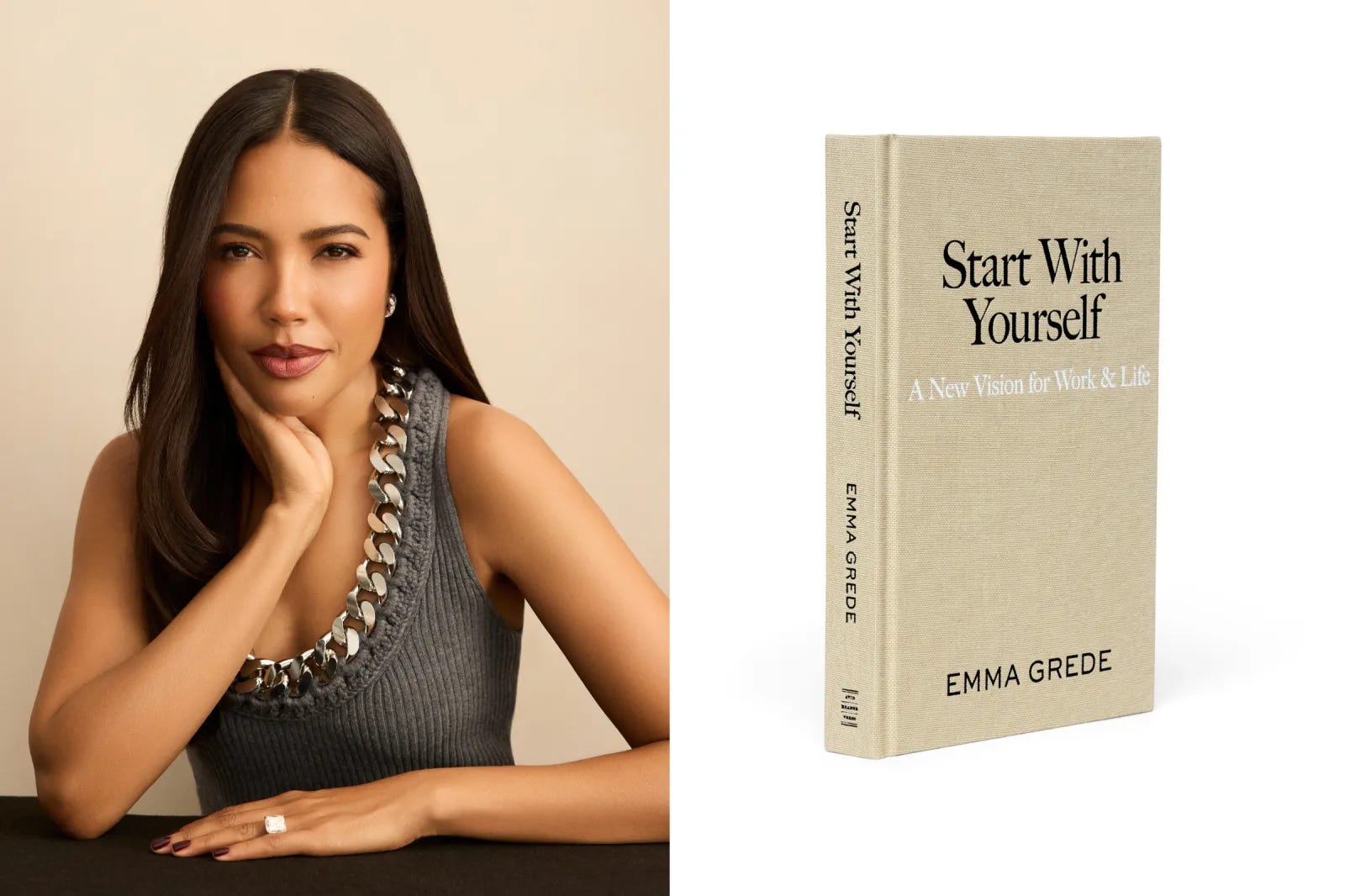
Emma Grede, the co-founder and CEO of Good American, founding partner of SKIMS, Off Season, and the voice behind the Aspire with Emma Grede podcast just released her debut book, Start With Yourself: A New Vision for Work & Life.
With little sugarcoating, the 43-year-old mogul lays out her roadmap for success while urging women to question what she calls “old thoughts”- the inherited, deeply rooted beliefs they are taught about ambition, money, careers and work-life balance.
And on the question of: “can you have it all?” She’s refreshingly honest: you can’t. Grede is clear that she doesn’t try to embark on an impossible balancing act. So what are her biggest takeaways at this point in her impressive career?
Stop the “Employee Mentality”
A powerful thread running through the book is the rejection of what she calls the “employee mentality” - waiting for permission, approval or a boss to tell you what comes next instead of taking the reins and advocating for yourself. She says that you have to think of yourself first because nobody else ever will. Her view? “Power has to be taken, no one is going to hand it to you,” she says.
Visualizing, Not Manifesting
Ambition, Grede says, is hard to maintain without clarity on what you want, why you want it and what you are willing to do to get there. But she separates it from the idea of manifesting:
“You can’t manifest your way to anything, or at least that hasn’t been my personal experience. So, when I talk about holding a vision for yourself, it’s like, what is the way that you want to live? What is the way that you want to show up? What are your principles? What’s important to you? And making sure that every decision you make is going in the direction of those things that are important to you,” Grede says.
She’s also encouraged other women to write down their dreams and financial goals, while identifying things they wouldn’t ever sacrifice. “I hold a vision for myself,” she added. “And I’m uncompromising.”
Persisting Through Uncertainty
The business leader counters the idea that people should stick only to what comes naturally. Talent helps, of course, but so does the ability to figure things out—not always by arriving at the perfect answer, but by having the mindset to work through uncertainty.
She writes the new thought as, “You will bring a particular genius to your career, and it’s your job to figure out what this is.” That means staying open, curious and willing to keep learning. It is an ethos Grede says she applies in her personal life, too, including in the way she has carved out time to experiment with AI and explore what it can do.
She says that women regularly stop themselves before they can reach their potential, getting trapped on the lowest rungs of the problem and being too intimidated to fully picture what they want and then pursue it. They convince themselves that they can’t start a business because they don’t understand every operational detail, but Grede says that doesn’t matter.
“Are you a visionary? Do you have a creative bone? Do you have something that you’re trying to do?” If so, she says, lead with that and then bring people onboard to fill in your gaps.
Embracing Fear & Resisting Perfectionism
“Risk is a requirement; playing it safe is the real danger. Risk is the bridge between who you are today and where you’re going,” she writes.
The fear of failure often keeps people from taking the leap in the first place. But throughout her own life, Grede says, failure has been less an ending than a catalyst, something to learn from, grow through and use as momentum for what comes next. She now reads fear as a “signal,” something that points to what is new, uncertain and worth aiming toward.
Part of her book’s argument for overcoming fear is about breaking the hold of perfectionism. Progress matters more than polish, and the only way into bigger, newer things, she suggests, is to stop overthinking and push past the fear.
More Candid Conversations
The mom-of-four calls for greater transparency among women. She highlights a need for frank conversations about money, motherhood, IVF, ambition, guilt, partnership and trade-offs.
“I think that we need to talk about everything. We need to share the details. But when I say talk, I don’t mean have a chat. I mean, get into the details, share the nitty-gritty, give the information that matters,” she says, adding that women often hear the broad strokes, like someone hired a lawyer or signed a contract, but don’t ever get into the specifics. How was the contract structured? What business lessons came from it? What mistakes were made?”

The World Isn’t Fair. So What?
She notes in her book that the world is rarely fair to women, but also that “fair” itself is a shaky ideal. Rather than debating and dwelling on women’s disadvantages, she urges them to start with themselves: to create opportunities, act on them and claim an active role. As she writes, “you are not a bystander in your own life.”
Controversy Comes With The Territory
Grede sparked criticism in 2025 when she described work-life balance as a “red flag” topic in job interviews on the Diary of a CEO podcast. Many felt the comments were tone-deaf to the structural barriers working women face. Grede hasn’t softened her stance but maintains that honesty, not pleasantries, is what will actually move women forward.
“I also think that we have to be really honest about where success really comes from, right? It’s like, you can’t consume your way to success. Watching successful people isn’t the same as becoming one,” she says. Grede does not gloss over hard work or romanticize success. Whether she refers to it “sweat equity,” grit, determination or ambition, hard work is at the core of success and there is no shortcut around it. “This book should feel like a wake-up call for ambitious women,” who want “money, power, career and families,” because ultimately, Grede says, it is “about self-leadership.”
Her Version of Work/Life Balance
In her interview with WSJ, she said that on the weekends, she’s busy doing activities that “fill my cup.” With that in mind, she avoids reading school emails or engaging in activities that she believes are “overparenting.”
Grede is the anti-thesis of the ‘trad wife’ poster child, Nara Smith. “Cutting sandwiches into star shapes? That was never it for me,” Grede said, explaining that her family’s team of nannies, cleaners, chef and chief of staff keep things running smoothly at home. She said that by establishing these parenting rules and delegating, she’s been able to manage a big family and successful career, like she’s always wanted.
Instead, she wants to use her time with her children to create “high-impact, core memories,” such as fishing trips and vacations to New York.
Why Can’t you Have it All?
Women ask Grede all the time whether they can have kids and be successful. Her answer is always the same: Yes, so long as you resist a culture that insists you perform perfectly in both spheres simultaneously.
“There are a lot of women who are overextended and exhausted—and loaded with guilt because they’re not living up to some sort of cultural ideal—and a lot of women who don’t think it’s worth the fight to even consider doing both. There aren’t many of us who are easily wearing a successful and vibrant career while feeling like we are also a good mother.”
“The maintenance of this balance—particularly in an American culture that bends so insistently toward the idea that a woman’s primary job needs to be in the home (#tradwife)—requires me to check my own masculine energy at the door when I come home at night. And I have a lot of masculine energy. I give direction and tell people what to do for most of the day. By the time I get home, not only do I want a break, but I need a reprieve. I do not parent my husband. I have never done that shit, and I never will.”
“Honestly, parenting is not that deep. It’s just not that deep. What your kids need: a lot of love, someone who sees them, someone they can depend on no matter what, moments of repair after big upsets, and guardrails. I don’t think my kids need me to hover over them in anxiety, worrying about every meal and every after-school enrichment opportunity. That’s not what my kids need from me, and I’m not a bad mum because I feel that way.”
“I’m very clear about controlling expectations and communicating clearly so that I don’t embark on an impossible balancing act where I’m under-delivering all over the place—and making others help me carry the guilt that results.”
…
So, what do you think of Emma’s vision of work and life?